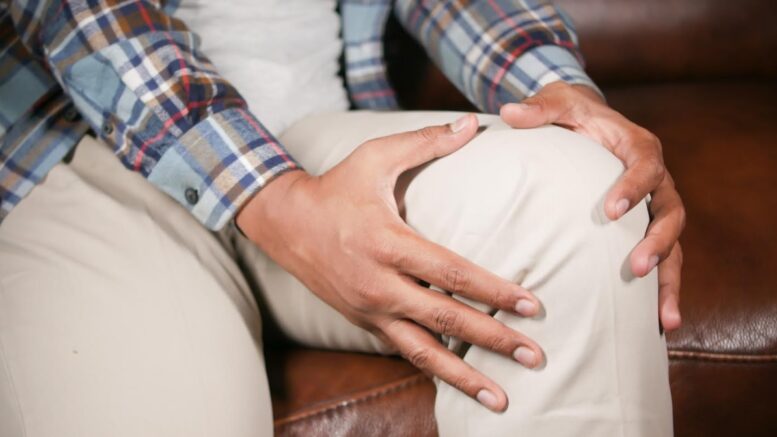
You take your first few steps in the morning and feel that familiar ache in your knee.
Maybe it eases up once you move around, or maybe it lingers, making every staircase or grocery trip feel heavier than it should.
You tell yourself it’s just getting older. Or maybe it’s the weather. But deep down, you wonder:
Why does this keep happening?
And why hasn’t it gone away, even after rest, ice, or stretching?
Here’s the truth most people never hear: knee pain isn’t always about “wear and tear.” It’s your body’s way of waving a red flag, asking you to look deeper at how you move, how you load your body, and how your system is managing stress and force from the ground up.
Let’s unpack what that really means.
The “Wear and Tear” Myth That Keeps People Stuck
If you’ve ever been told your pain is “just arthritis,” it’s easy to feel like your options are limited. But research tells a different story. Studies show that a large percentage of adults with arthritis or cartilage changes on imaging report no pain at all (Culvenor et al., 2019).
Pain doesn’t always match what we see on a scan. It’s often influenced by how your body moves, how your muscles support your joints, and how your brain interprets those signals.
When muscles stop activating properly or joints lose mobility, your brain picks up on the imbalance and starts to protect you by tightening muscles or changing your movement patterns. Over time, that protective response can become the problem.
That’s why so many people find themselves in a frustrating loop: the knee flares up, they rest, it feels better for a while, and then it returns as soon as they’re active again.
Why Your Knees Might Hurt When You Walk
Think of your body like a team. Every joint and muscle has a role. But when one player slacks off, someone else has to pick up the slack. More often than not, that someone is your knee.
1. Weak Links Up the Chain
When the glutes or core aren’t doing their job, the knees absorb the extra load. That repeated stress adds up over time, especially during walking, squatting, or climbing stairs.
2. Foot Mechanics That Affect Everything Above
If your arches collapse or your ankles roll inward, that misalignment transfers upward. Even a few degrees of change at the foot level can alter how your knees track and absorb force with every step.
3. Hip or Pelvic Instability
Your hips control the direction and rotation of your thighs. When they’re unstable, the knees are forced to compensate. These subtle shifts can create repetitive strain that builds over months or years.
4. Nervous System Overload
Pain that lingers for weeks or months can sensitize your nervous system. The result? Pain signals that fire more easily, even after tissues have healed. Research on chronic pain shows that this “central sensitization” process changes how the brain perceives movement and discomfort (Nijs et al., 2019).
Why Imaging Doesn’t Tell the Whole Story
An MRI or X-ray can show what your joint looks like, but not how it functions. Many people with degenerative findings on scans live pain-free, while others with normal imaging experience significant discomfort.
Pain is a whole-body experience that involves muscles, joints, the nervous system, and even emotional stress. Relying on images alone can cause you to chase symptoms instead of solving the root cause.
The Real Root Cause: How You Move
Knee pain is rarely just a knee issue. The knee sits between the hip and ankle, so it often suffers when those joints aren’t doing their part.
If your hips rotate inward or your foot collapses with every step, your knee is forced into an unnatural path again and again.
Movement-based physical therapy helps identify and retrain these patterns. By restoring proper coordination between your brain and muscles, you can reduce inflammation, improve load distribution, and protect your joints from future flare-ups.
What You Can Do Starting Today
1. Notice Patterns, Not Just Pain
Pay attention to when your pain shows up. Is it after sitting too long? After downhill walking? These details help uncover which movements are causing strain.
2. Move Every Day, Even Gently
Motion keeps joints lubricated and nourished. Short, frequent walks or light mobility sessions can help your knees feel better without aggravating them.
3. Strengthen the Support System
Your hips, glutes, and core are your knees’ best friends. When they’re strong, your knees stay protected and stable.
4. Strengthen Your Feet
Foot stability creates better knee alignment. Simple balance and intrinsic foot exercises can make a big difference.
5. Manage Stress and Recovery
Poor sleep and chronic stress amplify pain signals. Calming the nervous system through relaxation, breathing, or mindfulness practices supports physical healing.
6. Get a Movement Assessment
If you’ve tried everything and nothing sticks, a full-body evaluation from a skilled physical therapist can reveal the missing link. They can pinpoint compensations, retrain your brain-body connection, and help you move with confidence again.
The Bottom Line
Your knees aren’t wearing out. They’re asking for help. Pain is your body’s way of saying, “something isn’t working right.”
When you stop chasing pain and start looking at your movement as a whole system, from your brain to your feet, real healing begins.
If you’ve been stuck in the cycle of rest and recurrence, visit The Doctors of Physical Therapy to learn how a root-cause, movement-based approach can help you rebuild strength, balance, and long-term confidence in every step you take.
References
- Culvenor, A. G., Ruhdorfer, A., Juhl, C., Eckstein, F., & Øiestad, B. E. (2019). Knee osteoarthritis features on magnetic resonance imaging in asymptomatic uninjured adults: a systematic review and meta-analysis. British Journal of Sports Medicine, 53(20), 1268–1278. https://doi.org/10.1136/bjsports-2018-100062
- Nijs, J., Kosek, E., Van Oosterwijck, J., & Meeus, M. (2019). Dysfunctional endogenous analgesia during exercise in patients with chronic pain: to exercise or not to exercise? Pain Physician, 15(3 Suppl), ES205–ES213.