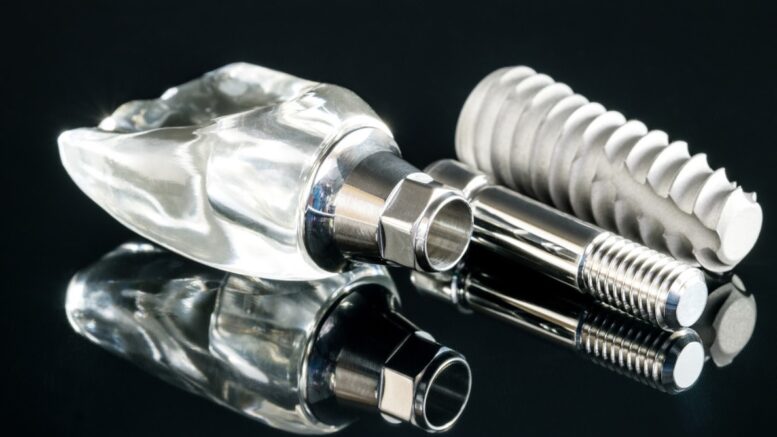
Predictable implant restorations aren’t built at the surgical appointment; they’re built through the prosthetic chain that follows. Even when an implant integrates perfectly, restorative complications can still occur if the prosthetic components are poorly selected, mismatched, or used without a clear plan for load control and maintenance.
This is why understanding implant prosthetic components matters. When each part is chosen with intent based on connection type, tissue conditions, restorative space, and occlusion the entire system becomes more stable, more hygienic, and easier to service long-term.
The prosthetic “stack”: the parts that turn an implant into a restoration
Most implant restorations are built from a few key component categories. The names vary across systems, but the biological and mechanical roles remain consistent.
1) Cover screw vs healing cap
- Cover screw: used when the implant is submerged during healing (two-stage approach).
- Healing cap (gingiva former): used to guide soft tissue and shape emergence during transgingival healing.
These parts don’t carry occlusal load, but they influence soft-tissue behavior and platform access, both of which affect restorative predictability later.
2) Impression coping or scan body
Before you can restore, you need to transfer the implant position accurately.
- Impression copings (open- or closed-tray) capture position in analog workflows.
- Scan bodies capture position digitally for CAD/CAM planning and milling.
If this step is compromised, improper seating, movement, or distortion, everything downstream becomes harder: poor fit, screw strain, occlusal errors, and higher complication risk.
3) Abutments: where restoration design becomes reality
Abutments are the “interface piece” between the implant and the prosthesis. Clinically, abutments are selected for three things: tissue control, angulation correction, and retention strategy.
Common abutment types include:
- Stock (straight) abutments: fast, efficient, useful when implant position is ideal.
- Angulated abutments: correct non-ideal trajectories, support prosthetic path of insertion.
- Custom abutments: best for esthetic zones and cases requiring optimized emergence and margin control.
- Temporary abutments: used for provisional restorations to protect biology and shape tissue.
Abutment choice influences soft tissue health, emergence profile, margin position, and the long-term maintenance profile of the restoration.
4) Multi-unit abutments: the full-arch workhorse
Multi-unit abutments are commonly used in full-arch and bridge protocols because they:
- create a consistent restorative platform across multiple implants
- allow screw-retained prostheses with predictable seating
- help manage angulation and restorative access
- simplify serviceability and long-term maintenance
In many clinical setups, multi-unit abutments are the difference between a full-arch restoration that is stable and serviceable, versus one that becomes difficult to maintain over time.
5) Prosthetic screws: small part, major mechanical role
Screws are the mechanical “clamp” that holds the assembly together. Most long-term screw problems are not about the screw alone; they’re about:
- torque protocol and retorque strategy
- fit accuracy and passivity
- occlusal overload and parafunction
- cantilever design
- repeated disassembly and wear
Torque discipline and correct component matching matter here more than many clinicians realize.
6) Ti-bases and hybrid workflows (digital restorations)
In CAD/CAM workflows, titanium bases (Ti-bases) are frequently used to bond or screw-retain a milled restoration. They provide:
- precise connection geometry
- a stable titanium interface for strength
- a predictable pathway for digital production
Ti-base workflows are popular because they combine digital efficiency with a strong connection interface, especially for zirconia or hybrid restorations.
How to choose components for predictable outcomes
Predictability improves when component selection follows a repeatable logic:
Step 1: Start with the connection platform
Internal hex, conical, external hex, every restorative decision must match the platform. Mixing systems or improvising compatibility increases mechanical and biologic risk.
Step 2: Plan restoration type early
- Screw-retained is typically preferred for retrieval and maintenance.
- Cement-retained may be chosen for access limitations, but requires strict cement control to reduce inflammation risk.
Step 3: Control emergence and hygiene access
A restoration that looks good but traps plaque is not predictable long-term. Emergence profile should support cleanability, stable tissues, and reasonable access for maintenance.
Step 4: Treat occlusion as part of prosthetics, not an afterthought
Many complications are force-related. Reduce non-axial loads, control cantilevers, screen parafunction, and protect the system mechanically.
The practical checklist: what to verify before final delivery
- confirm all components are platform-compatible
- verify stable seating (no rocking) at each interface
- confirm passivity of the restoration
- follow correct torque protocols and consider retorque where appropriate
- manage occlusion (especially in posterior and full-arch cases)
- ensure hygiene access and educate the patient
- document components used for future serviceability
These basics reduce complications more than most “advanced tricks.”
One-link resource for clinicians building component workflows
If you’re reviewing prosthetic options (abutments, healing components, temporaries, multi-unit solutions) within one platform ecosystem, here’s a single collection reference that can help structure component selection: implant prosthetic components.